
What is Spatial Diversity?
Spatial diversity in flow measurement refers to taking measurements at multiple locations or points within the flow rather than just one. Instead of relying on one data point within the pipe or channel, the meter will collect flow data from the cross-section to account for variations in velocity and flow characteristics.
Why Does Spatial Diversity Matter in Open Channel Applications?
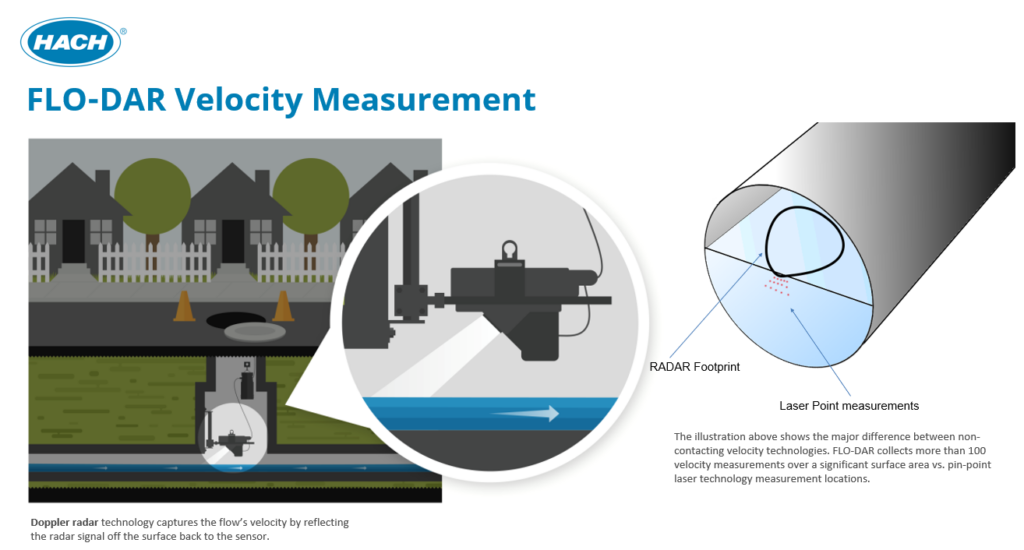
Turbulent flow is inherently chaotic, so relying on measurements from a single point is ill-advised. This is why most open-channel flow sensors employ some form of spatial diversity. One example of this is a laser flow meter whose beam can be focused on a dozen or more individual measurement locations. Combining velocity measurements from multiple points improves accuracy, compared to running the instrument in single-point mode.
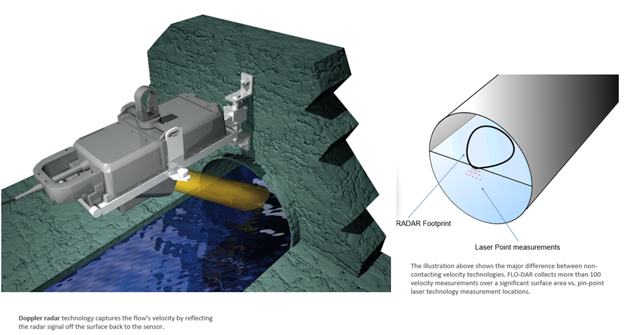
Radar flow meters have much wider measurement beams than laser instruments. A radar flow meter measures velocity measurements using a broad area on the water surface. This measurement “patch” may contain dozens or even hundreds of discrete measurement points; the instrument combines the return signals from all of these when determining the reported velocity.
What about Submerged Continuous Wave Doppler Sensors?
Submerged ultrasonic velocity sensors employ volumetric averaging; these instruments combine ultrasonic reflections from all targets within a quasi-conical volume in front of the sensor face. Typically, the cone starts near the bottom of the channel and opens slantwise towards the water surface. This large measurement volume may make submerged velocity sensors less prone to “sampling errors” than non-contact sensors, but often in wastewater applications, fouling, turbulence, and temperature stratification can cause problems for submerged sensor readings.
What Does Spatial Diversity Mean for Sensor Choice?
Spatial diversity is “built into” both radar sensors and submerged ultrasonic probes — it’s inherent in how they work. For laser sensors, spatial diversity is a setup option. Employing multiple measurement points increases both measurement time and power consumption proportionately. Operators often choose to disable it, either to save battery life, or to enable faster reading rates.
Radar sensors don’t require moving targets in the water, but they do require an irregular water surface (ripples or floaters) to get a reflected signal. Water that is devoid of suspended solids which might be too “clean” for laser sensors can be measured by radar sensors if there is sufficient surface reflectors. Slow moving water (<0.7 fps) may have a surface too smooth for radar technology and insufficient solids (all the solids settled out upstream) to support laser measurement.
Spatial Diversity in the FLO-DAR®
The FLO-DAR® AV Sensor, a Hach Flow solution by McCrometer, operates on non-contact radar technology and is available with the optional surcharge velocity sensor that will measure when submerged during surcharge. The FLO-DAR handles the turbulent, chaotic flow of open channel wastewater applications successfully due to its radar technology.
Compared to other products on the market for open channel wastewater applications, the FLO-DAR offers greater uptime and high accuracy with minimal fouling issues due to its positioning out of the flow. Other products utilize permanently submerged sensors or pressure transducers affixed to the bottom of the pipe, often failing or fouling due to the debris in the flow or settling sediment.
Submerged velocity probes are fouled by debris as wetted meters, which is why they’ve become less popular for open channel wastewater applications. Single point sensors, or continuous wave doppler sensors, can be easily fouled. Sensors and meters that take in multiple points of measurement are more accurate, especially in high-debris flows and streams with velocity gradients. The ±5% accuracy that the FLO-DAR provides for flow measurement is based on a continuity equation developed by the Hach Flow by McCrometer team. FLO-DAR’s fast foray transfer (FFT) takes multiple measurements and when seeing an outlier, it will exclude it. This is a part of the algorithm developed for the product to maintain accuracy, which is based on the relationship between surface velocity and level measurement. The raw data from FLO-DAR is averaged before posting a number, which is easier for users to read and utilize for decision-making. As for battery life being a concern with a multiple point measurement sensor like the FLO-DAR, this product offers one of the best battery lifespans on the market without compromising accuracy or functionality.
The Added Benefits of Spatial Diversity in the FLO-DAR
The FLO-DAR is successful in these chaotic wastewater applications due to the radar technology and accompanying surcharge velocity sensor (SVS) as well as the proprietary algorithms developed by the Hach Flow by McCrometer engineering team. Unlike other products on the market, including laser technologies, the FLO-DAR’s spectral diversity allows it to remain accurate even when site conditions and hydraulics change; some sensors only use multipoint during calibration. This is beneficial to customers utilizing communication outputs that signal or trigger actions such as chlorine injection or other water treatment processes. Without accurate, automated data that is dependable, process automation cannot proceed correctly.
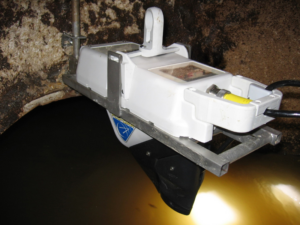
Ultimately, the FLO-DAR’s operational technology and inherent spatial diversity benefits wastewater applications with even the most difficult conditions including flows with high solids content, high temperature, shallow and caustic flows, man-made channels, and high velocities up to 20 ft/s.