
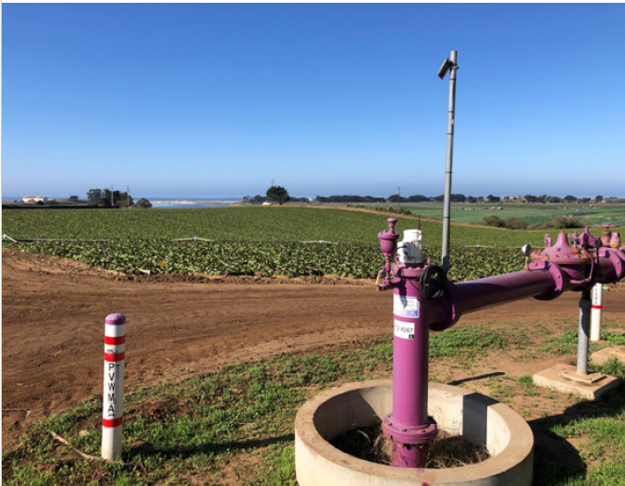
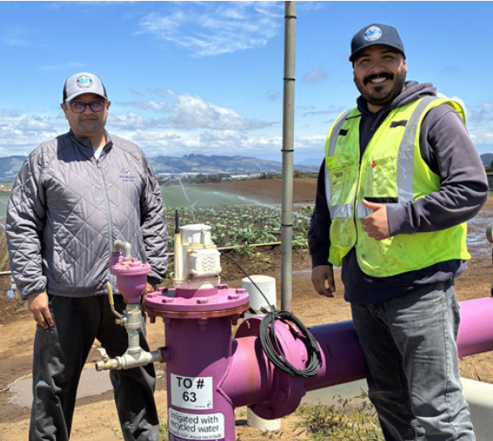
The future of water conservation is digital, says the team at Pajaro Valley Water Management Agency (PV Water), located on California’s Central Coast. While other agencies rely on nondigital meters, PV Water uses telemetry in its water meters to glean the most accurate data about its water flows. This technology can be more accurate, the PV Water team argues, than satellite imagery, which is often off by 20–30 percent. In this interview, PV Water staff, alongside a representative from McCrometer Inc., the agency’s meter provider, talk about water measurement, accuracy, and what it takes to be sustainable. In an area with a limited water supply, the movement toward sustainability via water measurement accuracy is crucial for future generations. Read on to learn more about the history of PV Water, the unique problems its area faces, and how the team is addressing them through an intentional move toward data digitization.
Irrigation Leader: Would each of you tell us about your background and how you came to be in your current position?
Shinehah Bigham: I started in 1999 as a field tech in PV Water’s meter program. I have served as the meter program coordinator and water system operator, and now I am the operations and maintenance manager.
Leonard Villanueva: I’ve been with PV Water since 2005. I started out as a field tech and moved up to meter program coordinator, the position I’ve been in ever since.
Marcus Mendiola: I’m the water conservation and outreach specialist. I started as an intern in 2012, and I’ve been full time since 2015. It’s a pleasure to oversee our ag conservation program, to lead our urban conservation program, and to work closely with my colleagues Shinehah and Leonard. I also enjoy writing our newsletters and our annual reports. My favorite part of the job is giving tours of our recycled water facility and showcasing the importance of protecting our groundwater basin through alternative water supplies.
Logan Pinkerton: I started with McCrometer in 2014 as an intern in customer service. I later moved into sales, and I now serve as the key account manager for the West Coast territory.
Irrigation Leader: Please introduce PV Water.
Marcus Mendiola: PV Water is a state-chartered water management district formed to manage and supplement water supplies to address groundwater overdraft. We are celebrating our 42nd anniversary this year. PV Water manages a coastal groundwater basin covering approximately 120 square miles. About 100,000 people call this valley home; it also includes some of the most valuable farmland on earth. The most recent estimate for crop values in our basin was $1.2 billion, with indirect value increasing the value of agricultural production to $1.9 billion. To protect farming and to reduce groundwater demand, PV Water has built almost 30 miles of distribution pipeline, delivering alternative water sources from surface water projects, recycled water facilities, recharged surface water recovery, and groundwater to farms along the coast of our groundwater basin.
Irrigation Leader: Why was PV Water founded?
Marcus Mendiola: Groundwater overdraft has been a known issue in the Pajaro Valley since the 1950s, before the agency was founded, when a white paper acknowledged that seawater intrusion caused by excessive pumping was starting to affect wells along the coastal edge of the aquifer and at the end of the Pajaro watershed. Artesian wells that had previously flowed out naturally were no longer flowing, indicating that the aquifer was no longer full and under pressure. The levels were going down, and farmers were starting to get salty water in the wells closest to the coast, so there was a collective knowledge of the problem.
Agriculture is the largest water user in the Pajaro Valley, accounting for about 80 percent of total water use. It’s also the economic driver of most jobs in the community. We want to preserve that, and we want to keep growing food in the area, but we must do this as efficiently as possible.
Early in the 1980s, the community said, “Let’s create a local special district so that the state government doesn’t come down from Sacramento and tell us what to do.” A local legislator passed our agency enabling act, and we were founded in 1984, allowing the community to address these problems locally while preserving agriculture.
Irrigation Leader: What kinds of solutions has PV Water put in place to address those issues?
Marcus Mendiola: Our constant goal is to try to lower the percentage of water used that is sourced from groundwater. In 1984, when our institution was formed, we originally wanted to connect to the Central Valley. But locals resisted the hefty expense, so PV Water refocused on local solutions: creating local water supply solutions to alleviate groundwater overdraft and to start to push back on seawater intrusion.
The first project we built was a recharge basin in a superficial aquifer. We pump water from the Harkins Slough into a basin. We have wells that can pull water from that shallow aquifer and send it to growers along the coast. That was the agency’s first local solution, making up a short section of what is now the coastal distribution system (CDS). Over time, we added a recycled water facility and expanded the CDS. Today, it is a 23‑mile pipeline delivery system for alternative water sources, and groundwater pumping in the coastal area that was affected by saltwater intrusion has been reduced.
More recently, the agency has built another large water supply project, the College Lake Integrated Resources Management Project, which draws from a naturally occurring lake to provide another alternative to groundwater.
We also have an adaptive agricultural conservation program to find ways to use groundwater more efficiently and effectively. For the last 12 years, I’ve been overseeing that program. It bloomed during our historic 2014–2016 drought, some of the driest years ever recorded in California. Growers have gotten more serious about their water use, and our ag conservation program has continued to grow to support their efforts.
The passage of the Sustainable Groundwater Management Act (SGMA) in 2014 made it easier for us to do our job. California was one of the last states to pass groundwater legislation, and we’re now in the implementation phase of reaching sustainable groundwater resources by 2040.
Irrigation Leader: What were the early years of the agency like?
Shinehah Bigham: After the agency was formed in the early 1980s, the first, most controversial ordinance that the board passed was the meter ordinance, which required meters on all the large agricultural wells. The agency was repeatedly sued for requiring people to have meters on their wells and charging an augmentation charge for the amount of water they pulled out of the groundwater basin. Those fees are used to build all these projects to help us come into sustainability.
Marcus Mendiola: Growers in our community are more aware of these issues now than ever before, and there’s been a lot less conflict than during the 1990s. In the early years, most of PV Water’s resources were used to defend our right to manage local groundwater, because growers didn’t want to be charged for groundwater. Once the lawsuits were settled, progress on water projects has really picked up steam.
Farmers want to protect their property rights, but at the same time, we’re all pulling from a shared resource. If we don’t collectively work toward a solution, we will collectively suffer. Over time, farmers have realized how true this is. Over the years I’ve been with PV Water and since the passage of SGMA, the fighting has subsided, so we can focus our efforts on reaching sustainability.
Irrigation Leader: How do you communicate to growers the benefits of these measures?
Marcus Mendiola: One of the joys of working at a small institution such as PV Water is that you quickly get to know all the power players in the community. We work closely with the Farm Bureau, which understands that to support agriculture, we must be able to track water use and therefore need accurate meters. This area may be small compared to the Central Valley, but we grow some of the best, most valuable produce in the world. The berry and vegetable companies in this area really care about the accuracy of their fertilizer and water applications and their ability to continue growing into the future. The owner of the largest berry company on earth was standing right behind the governor of California as he signed the three acts that became SGMA. The local agricultural companies believe in our mission, and they’ve been very supportive throughout the years, making sure that we can build projects and reach groundwater sustainability while they continue to farm.
Shinehah Bigham: We’ve found the sense of shared responsibility to be compelling for skeptics. We describe the groundwater basin as a punch bowl in which we all have straws. If your neighbor pulls water out, that affects the level of the punch bowl, and that affects your well. We explain how everyone pulling water out at a rate faster than it can be replenished pulls seawater into the groundwater basin. Meters are a way to share responsibility. They also help inform users’ irrigation practices and improve chemigation efficiency. We allow modifications to our meters to connect to customers’ variable-frequency drives for pumping efficiency. McCrometer provides most of our meters. Its propeller meters have proven to be the ideal application for large agricultural wells because of their sturdiness and reliability.
Irrigation Leader: Please tell us more about the meters you use and what you use them for.
Marcus Mendiola: Our distribution system is supply limited. The foundation of any type of conservation is quantifying the resource baseline; then, you can start conserving. Accurate meters give us that baseline. The meters on our distribution system give us specific data on how many gallons per minute are going out to each ranch. That helps us to be specific and accurate with use and helps each grower to conserve as much as possible.
Shinehah Bigham: I was talking with one of our vegetable growers the other day, and he said that with the cost of everything nowadays, his operation is now focusing more on sustainability. It relies on its telemetry meters to inform its irrigation decisions. We are a sustainability agency, and now the farmers are becoming more sustainable because they have to.
Marcus Mendiola: Meter data are the foundation of our ag program. Farmers are pushing more automation as well, because they need to save on every part of the growing process. Costs are getting to the point at which if they don’t conserve, they’re not going to have a profit at the end of the season. They’re trying to automate the application of water and fertilizer. They’re even trying to use robots to weed and self-driving tractors. The belt-tightening is at a level they haven’t seen before, and accurate data help them out with that.
Leonard Villanueva: We are able to service McCrometer Water Specialties meters on our own. It’s the only meter that I can rip apart, put back together again, calibrate, and put back out into the field. Telemetry meters give us data every 15 minutes. We don’t have to go out every quarter and spend a week reading meters. We know when a meter goes down, and we can work on it quickly. Water Specialties meters have helped our agency and have helped the growers we serve manage their flows, their start times, and their off times.
Irrigation Leader: Do you have any success stories of how farmers have used metering data to improve efficiency, reduce costs, or protect the water supply?
Leonard Villanueva: Telemetry has been helpful for our farmers. It helps them understand when to turn off water and whether the water has been running for too long. Paying attention to these things can save a ton of water.
Shinehah Bigham: It makes the biggest difference for larger growers, but it also helps smaller growers. The larger companies can afford to invest in more automation and different kinds of conservation infrastructure. Telemetry data help them implement their conservation and automation programs better. Some of the growers on the CDS have shared with me that the telemetry data help them see whether their irrigators are applying the right amount of water; the data also help them plan water use for their current and future crops.
Irrigation Leader: How does metering compare to satellite-based solutions?
Marcus Mendiola: Satellite imagery can be so inaccurate. It’s getting marginally better, but it’s just not there yet. A manager in the Central Valley said during a webinar that satellite is too inaccurate for farmers and groundwater managers alike. I think water meters are the best way to understand the groundwater extractions happening in a basin. If agencies are serious about sustainability and water conservation, they will choose to go with meters over satellite imagery.
Shinehah Bigham: One satellite company even asked for our meter data to compare and correct its satellite imagery data.
Logan Pinkerton: Satellite, to me, is a stopgap measure for districts that have not yet implemented metering. It provides a jumping-off point, but knowing the water scarcity that we all face, we need the most accurate measurements possible.
Irrigation Leader: What other technological advances can data collection enable?
Logan Pinkerton: McCrometer is working on some applications for new WaterSMART grants from the Bureau of Reclamation right now. One of the priorities for the WaterSMART program is the implementation of AI in water management. That’s part of the justification we are using in these new grant applications. You won’t have the data for AI without gathering digitized data. With telemetry meters, we can gather the data for tomorrow’s AI applications for water management.
Shinehah Bigham: Even before AI, when I started at the agency in 1999, we were collecting data from our wells. We now have decades of historical data that informs our groundwater model. It’ll never be completely AI, because all those data are based on physical, actual things in the field—drops of water.
Marcus Mendiola: Well said, Shinehah. Is AI going to replace a meter? No, it’s not. Is AI going to change a valve? No, it’s not. Even though the farm is getting more digital, it’s still going to have that human aspect. Even though our jobs are getting more digital, PV Water is not going to go from 15 employees to zero.
Irrigation Leader: What advice do you have for other water management agencies based on your experience?
Shinehah Bigham: Since the passage of SGMA, groundwater basin management agencies have formed, and they are just now starting to meter well water. We are often asked by folks from newer agencies how we implemented our meter program. Because we’re a government agency, nothing is proprietary. We have ordinances, procedures, and forms for all the different parts of the meter program, and we regularly share them with other agencies.
Leonard Villanueva: We tell other agencies and growers that you must have a meter you can repair. We have some McCrometer meters from the 1990s that are still in service, because we basically just rebuild them and put them back out there.
Irrigation Leader: What is your vision for the future?
Marcus Mendiola: Our vision for the future is a groundwater basin that has reached sustainability. That can be achieved through precision, accuracy, and knowing exactly when and how water is coming out of the ground at every single well. This information helps and supports farmers in knowing how much to use. Again, it’s not just water. We tell farmers that when they understand how much water is going out, they understand how much fertilizer is being used, too. That gets their plants just what they need and increases their yield. With the meters, the future is accurate, almost at the plant level. Reaching sustainability starts with a way of knowing how much water is coming out of our groundwater basin.
Digitizing these data is really helping us work toward sustainability. In the 14 years I’ve been here, agriculture has gone from using about 90 percent of the water in the valley down to 80 percent. That 10 percent savings is humongous, and I think we will see another 10 percent savings in the next 15 years. The global average for ag water use is about 70 percent. If we’re at 80, I believe our growers could get to 70, if not below.

Shinehah Bigham is the operations and maintenance manager for the Pajaro Valley Water Management Agency. She can be reached at bigham@pvwater.org.

Marcus Mendiola is the water conservation and outreach specialist for the Pajaro Valley Water Management Agency. He can be reached at mendiola@pvwater.org
Leonard Villanueva is the meter program coordinator for the Pajaro Valley Water Management Agency. He can be reached at villanueva@pvwater.org.
Logan Pinkerton is the key account manager for the West Coast territory at McCrometer Inc. He can be reached at loganp@mccrometer.com.