
In addition to ensuring financial stability, water utility rate structures are often used to promote conservation, support equity, and secure funding for future investments. There are many different rate types, such as flat rates, block rates, and seasonal rates. It’s important for all utilities to continually reevaluate and adjust their rate structures to confirm that they serve their needs.
For decades, water utility managers and lead engineers have relied on traditional, labor-intensive processes to evaluate and establish rate structures. This may involve consulting historical manuals and handbooks, as well as reviewing current regulations. The final plan must balance regulatory compliance, conservation incentives, and full cost recovery for capital and debt services. Thankfully, the emergence of AI is accelerating this process, allowing utilities to establish reliable, data-driven rate structures.
Why Flow Accuracy Is The Foundation
While AI offers powerful analytical capabilities, it is only as effective as the quality of the information it receives — as the saying goes, garbage in, garbage out. For a utility to utilize AI for cost allocation, it must first have an infrastructure of highly accurate flow measurement technologies.
The primary goal of these instruments is to provide a totalized volume of water per meter alongside a timestamped flow rate. This level of precision allows AI models to accurately associate specific costs with different customer classes — ranging from a single restaurant to an entire school district — and identify which classes are driving peak capacity costs.
Precision In Closed-Pipe Systems
Meters are needed at more than just endpoints. Within water treatment, storage, and pumping facilities, utilities rely on inline flow meters and newer insertion meters for approximately 80% to 90% of facility measurement needs. These technologies are critical for:
Tracking production: Measuring the exact volume of water entering and leaving the facility.
Non-revenue water analysis: Identifying water loss within the system by comparing water billed versus water treated.
Customer billing accuracy: Ensuring every drop of water pumped into the distribution network is accounted for and billed to a customer.
By feeding this precise operational data into an AI system, managers can continuously reevaluate cost recovery and distribution over customer bases while tracking the impact of conservation efforts on revenue.
Navigating Open Channel Challenges
Rate setting becomes more complex when accounting for open channel flow in stormwater and wastewater treatment systems. During wet seasons, the increased volume of water requires significant investment in treatment processes.
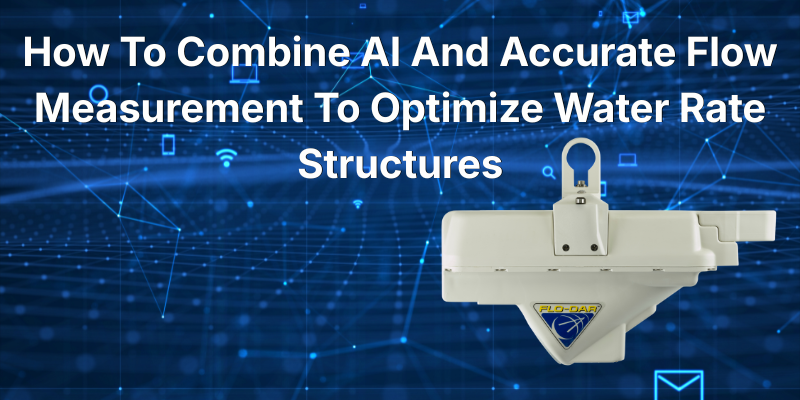
To manage this, tried-and-true non-contact radar flow meters are the preferred technology. These systems can measure both velocity and depth of flow with high accuracy without being submerged. This precise data allows AI to perform event tagging, distinguishing between dry and wet weather seasons to help managers forecast surcharges and plan capacity for the year. Without the reliable velocity measurements provided by radar, AI-based forecasts for treatment expenses would be based on inconsistent or erratic readings, leading to over-investment or budget shortfalls.

A rendering of McCrometer’s FLO-DAR® Area Velocity sensor.
Communication And Auditing
AI can do more than perform the complex calculations needed to set effective rates. These tools can also serve as an assistant, helping to translate complex flow data into public-facing information. For example, utilities can use AI to:
Develop transparent rate justifications. Managers can create detailed summaries and talking points for city council meetings, where they may have to get approval for rate changes.
Enhance public trust. Most basic AI tools are able to generate FAQs and PR packets for municipal websites that explain how rates are calculated.
Support compliance auditing. Utilizing AI allows utilities to identify anomalies in flow data and build documentation for legal challenges or regulatory violations, such as those related to California’s Title 22 recycled water standards.
The Hybrid Future
Technological progress is inevitable in every industry, and the municipal water market is no exception. Despite fears of AI being used to replace people, the future is far more realistically moving from human-only operations to a hybrid functionality where humans leverage AI as a valuable assistant, providing information and insights more quickly than a person can achieve alone. Software platforms are already beginning to centralize data from various metering points into real-time dashboards. These systems allow for automated compliance reporting and more sophisticated data management. However, the success of these advanced layers remains inextricably linked to the reliability of the field instruments — the meters and sensors — that provide the raw evidence for every financial decision.