
Farmers and growers manage an abundance of information concerning their crops, such as planting timelines, weather forecasting, irrigation scheduling, and more. Careful and well-informed planning on the part of producers contributes to a successful livelihood, and staying up to date on best practices and current trends for efficiency is how agriculturalists thrive.
So, it is not groundbreaking news when we say that irrigation affects soil moisture. In fact, all successful farmers have a preferred method of monitoring their soil moisture and quality, whether that is a manual approach, utilizing remote sensing such as drones or satellites, or even soil moisture sensors and probes. Oftentimes, it is a combination of methods for best results and a balance between cost, precision, and labor.
For growers with on-farm flow measurement instrumentation, there is an opportunity to increase irrigation efficiency as well as soil moisture simply by monitoring irrigation data alongside soil moisture data. Utilizing flow data specifically to improve soil moisture can save on manual labor and time while also increasing irrigation efficiency for water savings.
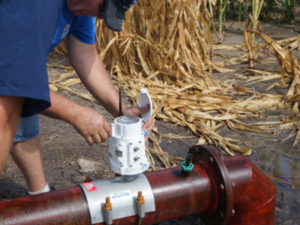
The Tools for Determining Soil Moisture
The agriculture industry offers a variety of methods and technologies for determining soil moisture, many of which are used concurrently to suit a grower’s time, labor, and budget needs.
- Soil moisture sensors/probes: These devices offer real-time, precise soil moisture data sent conveniently to a software system or dashboard for the grower to monitor from the palm of their hand. However, farmers must invest in a large quantity of probes to install across their acreage to receive adequate, useful data about their operations. This can be expensive as well as labor-intensive, as each probe must be manually inserted into the soil before irrigation season and removed before harvest.
- Remote sensing (drones and satellites): Measuring crop stress and moisture across farm fields, this method covers large areas by using drones and satellites equipped with sensors to provide data on surface level soil moisture variability and potential stress areas. While beneficial due to its non-invasive nature, it is less accurate than in-ground sensors.
- Feel and appearance: This traditional method requires expertise on the part of the grower who is required to manually walk their fields to feel soil texture and appearance to determine moisture levels. While budget-friendly, it is subjective and labor-intensive for farmers with large operations.
- Weather monitoring and evapotranspiration (ET): Growers with weather stations monitor water used by their plants and determine the evapotranspiration estimation, using that to manage the water applied by irrigation methods. ET models, which calculate the sum of water loss from soil evaporation and plant transpiration, may also use remote sensing data to estimate crop water usage as well. While non-invasive, this method often produces estimates that are off by as much as 20 – 60% due to variability in meteorological data and satellite resolution.
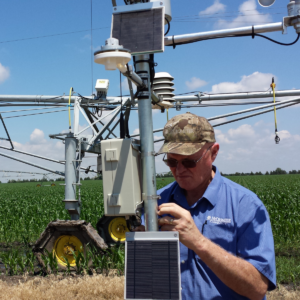
Knowing the Flow Benefits Your Soil
If you are a grower that is already metering on-farm, you have valuable data at your disposal. Most growers already monitor information such as weather data, crop health and growth stage, and field operations data, all with the purpose of cost tracking, labor management, and crop performance. Monitoring this data is what allows growers to operate in a precision agriculture environment and make informed, data-driven decisions that increase their bottom line.
Growers with a soil monitoring program or technique can utilize this data to optimize irrigation schedules. Each soil type has a different water-holding capacity; sandier soils have a smaller capacity whereas heavier clay soils have a heavier water-holding capacity. There is a point of diminishing return with irrigation, meaning that applying more water does not keep yielding more crops after a certain point.
By combining soil moisture and water application data, growers can increase irrigation efficiency. Scheduling your irrigation depends on the flow rate of your well, how many acres you are covering, and the time to run the irrigation system. Flow rates, acreage, and time are the three factors needed to calculate the depth of water application.
Evaluating irrigation efficiency: (Qt=ad) flow rate x time = area x depth of water applied
For instance, if by looking at your soil moisture data you deem there to be a deficit of one inch, you can now apply one inch of irrigation water (taking application efficiency into consideration) to fill the soil moisture void. You cannot set an accurate timer on your pivot or drip system to run the right amount of time to apply the right amount of water without knowing your flow rate. Utilizing soil moisture data in combination with flow data can simplify and save time determining if you are irrigating enough.
Growers spend time and effort striving for the right balance they must achieve with water application to their crops, knowing that a surplus of water is not only a waste of money but will leach nutrients out of the soil into the groundwater. An insufficient amount of water can stress the crops or hinder the productivity of the crop which affects crop yield and the grower’s bottom line. While there are many ways in which growers can manage their soil moisture and irrigation levels to achieve crop productivity, flow data provides an opportunity to do so with rapid precision, freeing up the farmer’s time to spend on other priorities.
Using Flow Data for Soil Moisture Management
Whichever method or combination of soil moisture sensing techniques you are using on your farm can be monitored in tandem with flow data to achieve greater efficiency and time savings. For optimal convenience and accuracy, it is recommended to utilize telemetry for continuous monitoring of both the volume and timing of irrigation water application.
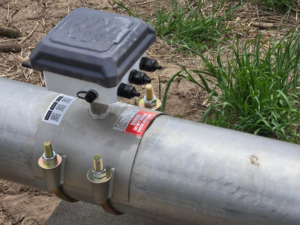
Without telemetry, growers would have to manually read their meters out in the field and manually create digital water use records, which may not provide enough data needed to make soil efficiency improvements on the farm. Telemetry makes water management easier due to the continuous stream of data, allowing growers to monitor applied water during a given period.
For instance, if a farmer is utilizing soil moisture probes or sensors in their fields, they can monitor that data and see an increase in moisture levels during an irrigation event. Each time the center pivot passes, they can see if it is filling the soil profile adequately and adjust the amount of water application. In this case, the grower is utilizing soil moisture sensor data and flow data as complementary tools to maximize crop yield while minimizing water waste.
Your Soil, Your Water, Your Data
The best way to manage your soil moisture is the method that works best for you and your farm, period. If your operational processes are working well and producing crop yields to your satisfaction, keep doing what you’re doing! If you are seeking additional methods of expanding efficiency on-farm and increasing your time and labor savings, utilize your existing flow data to better work for you and your irrigation needs.
Managing soil moisture is easier and more precise when accurate flow meter data is utilized. Monitoring flow data alongside soil moisture data allows growers to better manage their irrigation application to their fields, optimizing water usage and soil moisture to enhance crop yields. Investing in telemetry can equip farmers with the real-time data needed to make irrigation assessments as well as decisions about fertilizer application and planting strategies.